

Why Some Degrees Are Not Considered Equivalent in the USA
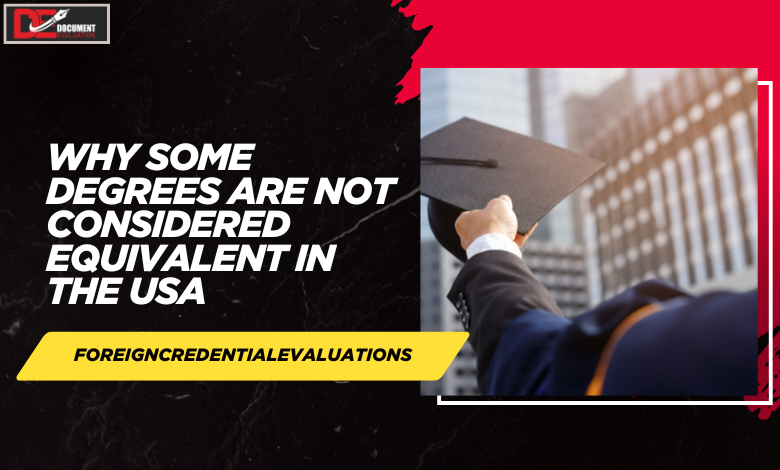
Why Some Degrees Are Not Considered Equivalent in the USA
You spent four years earning your degree back home. You worked hard, graduated with strong grades, and now you are ready to build your future in the United States. But somewhere between submitting your application and waiting for a response, you get a letter that effectively tells you your degree does not meet the standard. No explanation. No obvious next step. Just a quiet, frustrating wall.
This happens to thousands of international students, visa applicants, and foreign-trained professionals every year. And most of them never fully understand why. The United States does not have a single national education system that aligns neatly with every other country in the world, and the gap between what your home country considers a valid degree and what a US university or immigration authority recognizes can be surprisingly wide.
Understanding that gap is the first step to navigating it. Whether you are applying for graduate school, a work visa, or permanent residency, knowing exactly why your degree might fall short and what you can do about it is far more useful than hoping things will work out on their own.
The US Education System Does Not Translate Directly
The root of the problem is structural. The American higher education system is built around a specific model: four-year undergraduate programs, credit-hour accumulation, and a defined sequence from associate to bachelor to master to doctoral degrees. Every other country has built its own version of higher education, shaped by its own academic traditions, colonial history, and national priorities.
Some of those systems align well with the US model. Others do not come close. And the disconnect is not always about quality. A degree from a respected university in India, China, or Germany might represent genuinely excellent academic preparation, but if it was earned in three years instead of four, or if the coursework was structured differently from what American institutions expect, it will not be treated as equivalent without additional documentation.
The United States relies on credential evaluation agencies to make these comparisons. These organizations review foreign transcripts and degrees against US standards and issue equivalency opinions that universities, employers, and government agencies then use to make decisions. But the evaluation itself involves judgment calls, and the outcome depends heavily on factors most applicants never think about until something goes wrong.
Credential evaluation is not a pass/fail test. It is an interpretive process. The same degree from the same university can receive different equivalency determinations depending on which agency evaluates it and which US standard they apply.
The Most Common Reasons a Foreign Degree Fails Equivalency
There is no single failure point. The reasons a degree does not meet US equivalency fall into several distinct categories, and more than one can apply at the same time.
The Degree Was Completed in Three Years
This is the most common issue for applicants from countries like India, where a standard bachelor's degree has historically been three years rather than four. In the US, a bachelor's degree requires four years of full-time study, and a three-year degree from India is not automatically considered the equivalent of a US bachelor's degree.
This matters enormously for immigration purposes. H-1B specialty occupation visas and EB-2 green card categories both require a degree equivalent to a US bachelor's degree or higher. If your degree does not meet that threshold on its own, you need additional credentials or work experience to bridge the gap.
A three-year Indian bachelor's degree combined with a one-year postgraduate diploma or a master's degree is typically treated as equivalent to a US bachelor's degree. But that combination has to be documented correctly, evaluated by a recognized agency, and presented in a way that makes the equivalency clear to whoever is reviewing your file. Running an Advanced US Degree Equivalency Check before you apply is the cleanest way to know exactly where you stand.
The Institution Is Not Recognized or Accredited
In the US, institutional accreditation is the mechanism that certifies a college or university meets a minimum standard of academic quality. Not every foreign institution has an equivalent process, and not every foreign institution that has some form of government recognition will be treated as accredited for US purposes.
If your degree was earned at a university that does not appear in recognized international databases or that lacks the kind of credentialing that US agencies consider legitimate, the evaluation will reflect that. In some cases, the degree may be evaluated as non-equivalent regardless of the quality of the education you actually received.
This is more common than most people expect. Distance learning institutions, religious universities with limited academic recognition, and newer institutions that were not established long enough to build a track record all run into this problem regularly.
The Program Structure Did Not Match US Expectations
Even when the degree level and the institution check out, the internal structure of the program can create problems. US bachelor's degrees are expected to include a mix of major coursework, general education requirements across multiple disciplines, and elective credits. A highly specialized program that covered only the subject area without any general education component may be evaluated as a technical credential rather than a full bachelor's degree.
Similarly, programs that were completed through an unusual structure, such as part-time study counted as full-time, or credits transferred from unrecognized institutions, can complicate the equivalency picture in ways that are hard to resolve after the fact.
The GPA Conversion Does Not Work in Your Favor
Grade point averages are calculated differently around the world, and converting them to the US 4.0 scale is not as straightforward as dividing and multiplying. A first-class degree in the UK or a distinction in Australia may convert to a strong GPA. A high percentage score in India might look impressive but convert to something that appears mediocre on a US scale if done incorrectly.
This matters most for university admissions, where minimum GPA requirements are often stated as hard thresholds. Understanding how your grades will actually appear after conversion through a US GPA Converter is important before you decide which programs to apply to, so you are not surprised when your strong academic record appears to fall below a requirement you thought you easily cleared.
Never assume your grades will convert favorably without checking. Many applicants with genuinely strong academic records discover too late that their percentage or letter grade system does not map onto the US 4.0 scale in the way they expected.
How Different Countries Face Different Challenges
The equivalency problem is not uniform. Different countries have different specific issues, and knowing which ones affect your background helps you prepare the right documentation from the start.
India
The three-year bachelor's degree issue is the central challenge for Indian applicants. Beyond that, the sheer number of universities in India, many of which are affiliated colleges under a larger university system, creates verification challenges. Credential evaluators need to confirm not just that the institution exists but that the specific affiliated college and the awarding university are both recognized entities.
Indian applicants applying for H-1B or EB-2 status often need a combination of their bachelor's degree plus a master's degree or substantial relevant work experience to establish the US bachelor's equivalent. Getting a proper Advanced US Degree Equivalency Check early in the process helps map exactly which combination of credentials will satisfy the requirement for your specific situation.
United Kingdom and Europe
UK and European degrees generally convert more smoothly, but they are not without complications. The British honours degree system, the Bologna Process three-cycle structure, and the variety of national education frameworks across Europe all create nuances that evaluators have to navigate carefully.
A UK bachelor's degree is typically considered equivalent to a US bachelor's degree. However, a UK undergraduate qualification that does not carry honours, or a shorter foundation degree, may be evaluated differently. European applicants from countries with strong Bologna alignment generally do better than those from countries where the framework has been unevenly implemented.
China and East Asia
Chinese degrees from recognized institutions typically evaluate well, but documentation can be a challenge. Original transcripts, degree certificates, and verification from the China Higher Education Student Information system are often required. Applicants who do not have complete documentation or who attended institutions that are not listed in the relevant databases can face significant delays.
South Korean and Japanese universities generally produce degrees that evaluate smoothly, but specialized technical credentials and vocational qualifications can be harder to place on the US equivalency scale.
Latin America and Africa
Latin American licenciatura degrees, which typically require five years of study, often evaluate as equivalent to US master's degrees rather than bachelor's degrees. This sounds like an advantage, but it can actually complicate situations where a straightforward bachelor's equivalent is what the application requires.
African applicants face some of the most variable outcomes, largely because the range of institutional quality and recognition varies so widely across the continent. Degrees from established universities in South Africa, Nigeria, Ghana, and Kenya tend to evaluate predictably. Degrees from smaller or newer institutions in countries with less developed accreditation infrastructure face more scrutiny.
Where your degree comes from matters far less than how well documented, structured, and credentialed it is. A carefully prepared evaluation from a respected agency can make the difference between an application that succeeds and one that stalls indefinitely.
What USCIS Looks for That Universities Do Not
University admissions offices and USCIS adjudicators both care about credential equivalency, but they apply different standards and have different tolerances for ambiguity.
Universities often have flexibility to consider the overall profile of an applicant, weighing strong test scores or relevant experience against a degree that does not perfectly fit their standard profile. USCIS operates under a much more rigid legal framework. A visa category requires a specific degree level or its equivalent, and a determination that your degree does not meet that threshold is not something that can be offset by impressive professional accomplishments or a compelling personal statement.
For H-1B purposes, the specialty occupation requirement ties the visa to a specific degree field as well as level. A degree in the right field but at the wrong level will not satisfy the requirement. A degree at the right level in an unrelated field creates a different problem. Both situations require careful documentation and, often, a detailed equivalency opinion that addresses the specific standard being applied.
For EB-2 purposes, the advanced degree requirement means a US master's degree or its equivalent, or a US bachelor's degree (or its equivalent) plus five years of progressive post-baccalaureate work experience. Understanding exactly how your foreign degree fits into this framework requires the kind of country-by-country analysis that a proper Advanced US Degree Equivalency Check provides.
The Role of Recognized Evaluation Agencies
USCIS does not evaluate credentials itself. It relies on opinions from credential evaluation organizations, and not all such organizations carry the same weight. The most widely recognized agencies in the US are members of NACES (National Association of Credential Evaluation Services) or AICE (Association of International Credential Evaluators).
An evaluation from a recognized NACES member agency is generally accepted by universities, licensing boards, and immigration authorities. An evaluation from an agency that lacks this kind of professional affiliation may be questioned or rejected, which means you would need to obtain a new evaluation and potentially restart a delayed application process.
Always verify that the evaluation agency you choose is a NACES or AICE member before submitting your documents. A rejected evaluation from an unrecognized agency is not just an inconvenience; it can set your application back by months.
Try the Advanced US Degree Equivalency Check Tool
Before going through the full evaluation process, it helps to understand how your background is likely to be assessed. The tool below gives you a quick read of how your degree, country of education, and work experience are likely to line up against US standards for immigration and academic purposes.
Advanced US Degree Equivalency Check
Tell us about your background to see how it aligns with strict USCIS and University standards.
Mistakes That Hurt Your Equivalency Outcome
Most of the problems people run into during credential evaluation are avoidable. They are not the result of having a weak academic record. They come from making assumptions that turn out to be wrong, or from skipping steps that seem minor until they are not.
- Waiting until after a Request for Evidence to obtain a credential evaluation, when you should have had one before filing
- Choosing an evaluation agency based on price rather than recognition and NACES membership
- Submitting unofficial transcripts or photocopies when the agency requires original sealed documents
- Assuming that a high percentage score in your home country will automatically convert to a strong GPA on the US scale without using a reliable US GPA Converter
- Not checking whether your specific institution, rather than just your country, is recognized by the evaluation agency
- Applying for a visa category that requires an advanced degree when your credentials only support a bachelor's equivalent without additional experience
- Relying on a general evaluation when your specific application requires a detailed, purpose-specific opinion
How Work Experience Can Fill the Gap
When a degree does not meet the US equivalency threshold on its own, relevant professional work experience can sometimes bridge the difference. This is not a universal solution, and it applies differently depending on the context, but it is worth understanding.
For H-1B visa purposes, three years of relevant work experience in a specialty occupation can be considered equivalent to one year of college education. This means that a three-year bachelor's degree combined with twelve or more years of relevant professional experience might be evaluated as the equivalent of a US master's degree. The calculation has to be done correctly and documented thoroughly, but the pathway exists.
For EB-2 purposes, a bachelor's equivalent plus five years of progressive post-baccalaureate experience satisfies the advanced degree requirement. If your degree evaluates as a US bachelor's equivalent, your work experience record becomes a critical part of your petition rather than just a resume detail.
The key is that work experience in this context has to be documented with specificity, verified by employers, and evaluated by a qualified expert who can connect it to the academic equivalent being claimed. Vague references to years of professional work do not satisfy the standard. Detailed expert opinions that explain the professional responsibilities, level of technical knowledge required, and how the experience maps to graduate-level academic preparation are what actually move the needle.
Professional Licenses and Certifications
In fields where professional licensure is the norm, holding a recognized license can strengthen an equivalency argument significantly. A licensed engineer, nurse, pharmacist, or accountant whose foreign degree falls slightly short of US equivalency may be able to supplement their credential evaluation with documentation of their professional license and what was required to obtain it.
This is particularly useful in fields where the licensing exam itself serves as a quality control mechanism, effectively certifying that the holder's knowledge and skills meet a defined professional standard regardless of where they were educated.
If your degree falls below the US bachelor's equivalent threshold, document your work experience meticulously before pursuing any visa or green card category. Get employer verification letters that describe your specific responsibilities, not just your title and dates of employment. The detail matters when an evaluator has to make the case that your experience fills the academic gap.
Practical Steps to Prepare for a Successful Equivalency Review
The good news is that with the right preparation, most credential equivalency issues can be addressed before they become problems. These steps apply whether you are preparing for a university application, a visa petition, or a green card filing.
- Gather all original academic documents including transcripts, degree certificates, mark sheets for each year of study, and any postgraduate credentials you hold
- Research which evaluation agency is required or preferred by the institution or authority you are applying to, and confirm it is a NACES or AICE member
- Use a reliable US GPA Converter to understand how your academic grades will appear on the American scale before you apply to programs with stated GPA minimums
- Run an Advanced US Degree Equivalency Check to identify whether your combination of degree level, country, and program structure is likely to meet the threshold you need
- If your degree is a three-year bachelor's, identify whether a postgraduate diploma, master's degree, or work experience record can be combined with it to meet the required standard
- Request a detailed course-by-course evaluation rather than a general document evaluation if your application depends on demonstrating specific coursework equivalency
- If you are filing an immigration petition, consult an experienced immigration attorney who can review your credential evaluation before it is submitted and identify any gaps before the adjudicator does
Credential equivalency is not a fixed verdict. It is a process, and the outcome depends significantly on how well you document, present, and support your academic record. The same degree, presented carelessly or carefully, can produce completely different results.
The Bottom Line on Degree Equivalency
The United States has a rigorous, specific standard for what counts as a degree equivalent, and it does not apologize for the gap between that standard and how other countries structure their education systems. That gap is real, it affects thousands of applicants every year, and it is not going away.
But it is navigable. Understanding why your degree might not meet the US equivalency threshold, which combination of credentials and experience might address the shortfall, and how to present your academic record in the most accurate and favorable light are all things within your control.
Start with an honest assessment. Use tools like the Advanced US Degree Equivalency Check to understand where you stand before you file anything. Check how your grades will appear through a US GPA Converter so there are no surprises. Choose a recognized evaluation agency, gather complete documentation, and if you are pursuing an immigration benefit, get professional legal guidance on how your credentials fit the specific visa or green card category you are targeting.
The applicants who run into trouble are usually the ones who assumed everything would work out and discovered too late that assumption was wrong. The applicants who succeed are the ones who did the homework first. Be the second kind.